Agent: AI That Gets Things Done
Four capabilities: Plan / Tool / Memory / Act — click to see real-world cases
THE QUESTION THIS PAGE ANSWERS
ANSWER FIRSTWhat is the key idea behind “Agent: AI That Gets Things Done”?
Four capabilities: Plan / Tool / Memory / Act — click to see real-world cases
Make the claim earn its place. Use this page as a decision aid, not a definition to memorize. Connect the idea to one real task, one observable result, and one failure that would change your mind.
Write one question you could answer with evidence after trying this idea.
A conclusion that sounds complete but leaves the key assumption untested.
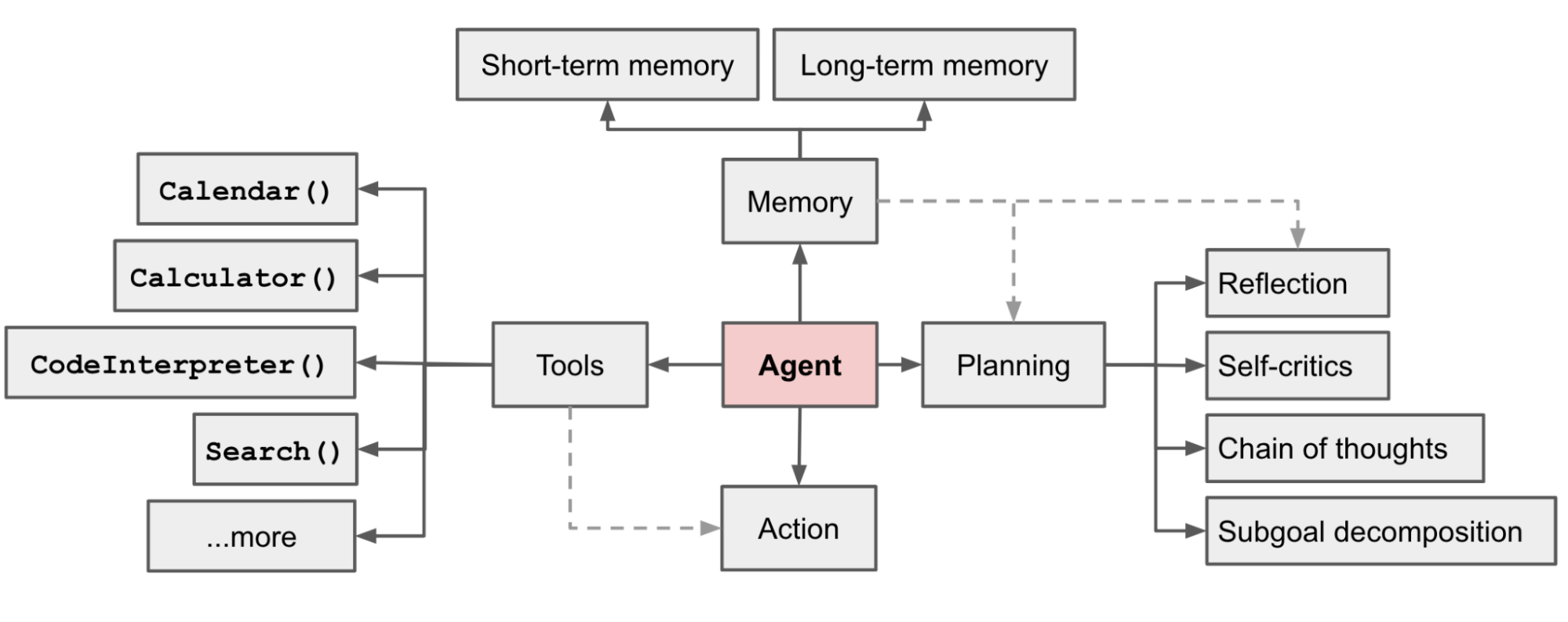

Many of the ideas in this lesson — and in this entire Agent Engineering chapter — come from her June 2023 blog post "LLM Powered Autonomous Agents". A deeply respected pioneer, she laid out the profoundly influential Agent architecture in the famous "crab diagram" above: the Agent (LLM) sits at the center as the brain, reaching out to Planning, Memory, Tools, and Action.
This one diagram has shaped the entire AI Agent industry — nearly every Agent framework today traces back to it. We highly recommend following her on Twitter/X.
Can only "say," cannot "do"
Why “The Classic Architecture · Where It All Comes From” can find relevant content
“Many of the ideas in this lesson — and in this entire Agent Engineering chapter — come from her June 2023 blog post "LLM Powered Autonomous Agents" .” moves retrieval beyond storing material: the real question is how to find what is relevant. That decision shapes the input quality of RAG, recommendation, and image-search systems.
Similarity is not the answer
In the flow described by “This one diagram has shaped the entire AI Agent industry — nearly every Agent framework today traces back to it.”, embeddings place items in a comparable semantic space and a neighbor index narrows the search. The final answer still depends on whether the retrieved chunks cover the question, whether the distance metric fits, and whether the evidence is current.
Separate findable from relevant
Turn “This one diagram has shaped the entire AI Agent industry — nearly every Agent framework today traces back to it.” into a small test: prepare queries with known answers, record relevance, misses, and distractors, then decide whether chunking, the index, or reranking needs to change.
From “The Classic Architecture · Where It All Comes From” to “Four Core Capabilities (from Lilian Weng's Architecture) · Click to Switch Demo”
“The Classic Architecture · Where It All Comes From” grounds the problem in “Many of the ideas in this lesson — and in this entire Agent Engineering chapter — come from her June 2023 blog post "LLM Powered Autonomous Agents" . A deeply respected pioneer, she laid out the profoundly infl…”. “Four Core Capabilities (from Lilian Weng's Architecture) · Click to Switch Demo” then moves it toward “🧭 Plan Breaks complex tasks into executable step sequences — think before acting 🔧 Tool Use Calls search, code execution, databases, and APIs — an extension of hands and feet 🧠 Memory Short-term context + lo…”. Together, they show that the lesson is not just a conclusion to remember, but a claim with conditions.
Carry the judgment into the next situation
The same logic applies to retrieval: define what counts as relevant, check whether recall covers the question, and then inspect whether ranking, chunking, or freshness pushed useful evidence out.
- “The Classic Architecture · Where It All Comes From”: Many of the ideas in this lesson — and in this entire Agent Engineering chapter — come from her June 2023 blog post "LLM Powered Autonomous Agents" . A deeply respected pioneer, she laid out the profoundly infl…
- “Four Core Capabilities (from Lilian Weng's Architecture) · Click to Switch Demo”: 🧭 Plan Breaks complex tasks into executable step sequences — think before acting 🔧 Tool Use Calls search, code execution, databases, and APIs — an extension of hands and feet 🧠 Memory Short-term context + lo…
- “The closing point”: This one diagram has shaped the entire AI Agent industry — nearly every Agent framework today traces back to it. We highly recommend following her on Twitter/X
The final “The closing point” brings the discussion to “This one diagram has shaped the entire AI Agent industry — nearly every Agent framework today traces back to it. We highly recommend following her on Twitter/X”. The useful thing to carry forward is knowing which judgments must be revisited when input, scale, or risk changes.
I turned one judgment from this article into a small experiment I could run today. Knowing what to observe next is more useful than simply remembering the conclusion.
After reading this, I first looked for the conditions behind the idea instead of copying the method into a project. That order made the later trade-offs much clearer.
When this judgment reaches real work, which constraint should be added first? I am curious which step matters most between reading and the first practical attempt.
No discussion on this article yet.