Input-Length Tiering: the 32k Red Line
One extra chunk can move the whole request into a higher input tier; use budget-aware truncation and stop paying double for RAG junk
THE QUESTION THIS PAGE ANSWERS
ANSWER FIRSTWhat is the key idea behind “Input-Length Tiering: the 32k Red Line”?
One extra chunk can move the whole request into a higher input tier; use budget-aware truncation and stop paying double for RAG junk
Read cost as a shape, not a single number. Break a request into input, output, retries, tools, and waiting time. The shape of usage usually tells you which design choice is expensive and where a smaller change can help.
Measure one real request before you optimize an imagined average.
A cheaper call that quietly creates more retries, latency, or review work.
| Input length (illustrative model) | Unit price ($/M, illustrative) | vs baseline |
|---|---|---|
| 0 – 32k | $1.60 | 1x |
| 32k – 128k | $3.20 | 2x |
| 128k – 252k | $4.80 | 3x |
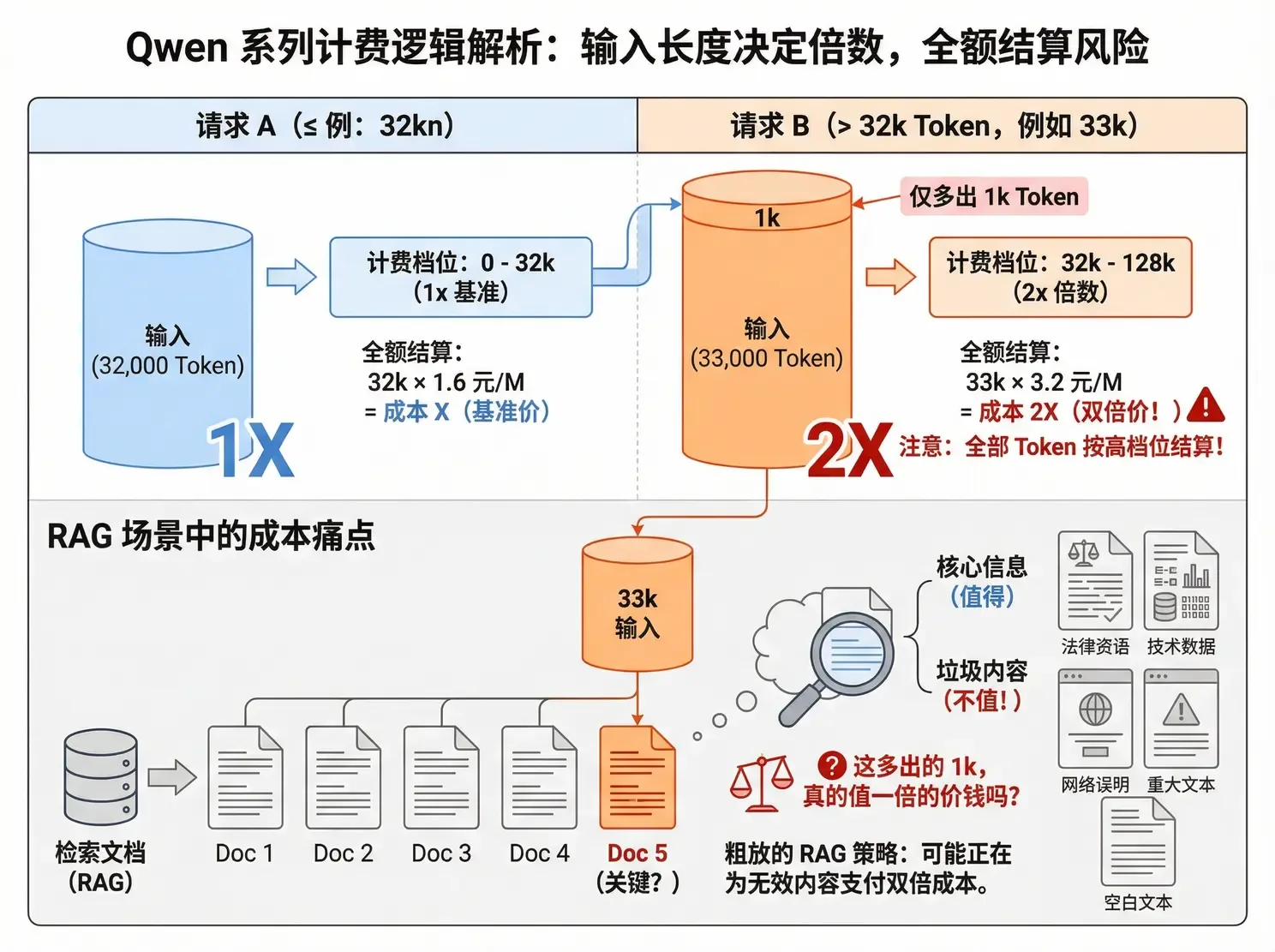
Say your input is 33,000 Tokens—only 1,000 over 32k. All 33k Tokens on the request bill at $3.20/M—not the first 32k at $1.60 and the last 1k at $3.20. That extra 1k doubles the whole request in this illustrative rate card.
Drag input length and watch what happens near the 32k and 128k red lines.
This gets especially sharp in RAG. Suppose retrieval returns 5 chunks that stitch to exactly 33k. Ask yourself: how much does the 5th chunk actually help the final answer?
If it's a core legal clause or a critical tech parameter, maybe it's worth it. But if it's a page footer, copyright notice, a duplicated paragraph, or even leftover newlines from formatting? Sloppy RAG strategies are paying double for junk.
The fix: turn “32k” from a bill shock you discover after the fact into a budget constraint written into code. Prompt assembly can't be mindless concat:
✗ Wrong: mindless concat| Scenario | Strategy | Notes |
|---|---|---|
| RAG retrieval | Dynamic Top-K | Don't always take 5 chunks—take until you're “about to hit 32k” |
| Multi-turn chat | History compression | Trigger Summarization when history nears 30k |
| Long-doc processing | Segmented processing | Don't stuff it all at once—use Map-Reduce |
| Vendor | Tier-jump type | Key threshold | Counter-strategy |
|---|---|---|---|
| Output-tiered provider | Output-length tier jump | 200 Tokens | Task splitting, or switch to a non-output-tiered model |
| Input-tiered provider | Input-length tier jump | 32k / 128k | Budget-aware truncation; dynamically trim context |
| Reasoning-enabled provider | Hidden reasoning buildup | Multi-turn inflation | Context scrubbing; discard when done |
Full-request billing changes the economics: in this pattern, a 33k request prices all 33k at 2×. One extra 1k can double the bill.
Ask “is the 5th chunk worth it?”: sloppy RAG pays double for footers, disclaimers, and newlines.
Encode 32k as a budget constraint in code: sort by relevance, stop at budget. Dynamic Top-K beats fixed Top-K.
Source: Adapted from the author's internal team share “AI Token Cost Engineering Strategies,” section “Input-Length Tiering.” The rate card is an illustrative teaching example; verify live thresholds and full-request billing rules with the provider you deploy. RAG cost and optimization also appear from another angle in LLM Fundamentals · RAG Costs & Optimization Strategies—worth reading side by side.
The complete interaction cost of “The pattern: 1k more Tokens, whole bill doubles”
“Say your input is 33,000 Tokens—only 1,000 over 32k.” is a reminder that AI cost is not one price multiplied by one call. Input, output, retries, tools, waiting time, and human cleanup together decide what a task really costs.
Find what the bill repeats
The key variables behind “Drag input length and watch what happens near the 32k and 128k red lines” are usually repeated context, oversized output, retries after failure, and calls that do not produce useful progress. Removing wasted Tokens can reduce cost, latency, and concurrency pressure at the same time.
A cheaper call can make the whole workflow more expensive
Start with “Encode 32k as a budget constraint in code: sort by relevance, stop at budget.” and keep a small table for input, output, retries, tools, and human review. Compare quality before and after optimizing instead of looking at one price in isolation.
From “The pattern: 1k more Tokens, whole bill doubles” to “Interactive Demo · The bill on the ladder”
“The pattern: 1k more Tokens, whole bill doubles” grounds the problem in “Say your input is 33,000 Tokens—only 1,000 over 32k. All 33k Tokens on the request bill at $3.20/M —not the first 32k at $1.60 and the last 1k at $3.20. That extra 1k doubles the whole request in this illustrat…”. “Interactive Demo · The bill on the ladder” then moves it toward “Drag input length and watch what happens near the 32k and 128k red lines”. Together, they show that the lesson is not just a conclusion to remember, but a claim with conditions.
Carry the judgment into the next situation
When analyzing cost, map the complete interaction first, then find repeated input, wasted output, and retries. A cheap individual call does not make the whole task cheap.
- “The pattern: 1k more Tokens, whole bill doubles”: Say your input is 33,000 Tokens—only 1,000 over 32k. All 33k Tokens on the request bill at $3.20/M —not the first 32k at $1.60 and the last 1k at $3.20. That extra 1k doubles the whole request in this illustrat…
- “Interactive Demo · The bill on the ladder”: Drag input length and watch what happens near the 32k and 128k red lines
- “The closing point”: Encode 32k as a budget constraint in code: sort by relevance, stop at budget. Dynamic Top-K beats fixed Top-K
The final “The closing point” brings the discussion to “Encode 32k as a budget constraint in code: sort by relevance, stop at budget. Dynamic Top-K beats fixed Top-K”. The useful thing to carry forward is knowing which judgments must be revisited when input, scale, or risk changes.
I turned one judgment from this article into a small experiment I could run today. Knowing what to observe next is more useful than simply remembering the conclusion.
After reading this, I first looked for the conditions behind the idea instead of copying the method into a project. That order made the later trade-offs much clearer.
When this judgment reaches real work, which constraint should be added first? I am curious which step matters most between reading and the first practical attempt.
No discussion on this article yet.