Evolutionary Search: Survival of the Fittest Harness
AlphaEvolve / DGM / SIA — using evolutionary algorithms to discover optimal Agents in vast design spaces
THE QUESTION THIS PAGE ANSWERS
ANSWER FIRSTWhat is the key idea behind “Evolutionary Search: Survival of the Fittest Harness”?
AlphaEvolve / DGM / SIA — using evolutionary algorithms to discover optimal Agents in vast design spaces
Make the claim earn its place. Use this page as a decision aid, not a definition to memorize. Connect the idea to one real task, one observable result, and one failure that would change your mind.
Write one question you could answer with evidence after trying this idea.
A conclusion that sounds complete but leaves the key assumption untested.
2. No gradients, but easy to evaluate: you can't differentiate through prompt text, but you can directly run benchmarks and get a score.
3. Diversity has value: different tasks may call for different Harness styles; evolution naturally maintains population diversity.
GEPA (Agrawal et al. 2025): combines reflection-based prompting with evolutionary search. The Agent first reflects on the current prompt's weaknesses, then produces candidate improvements via evolutionary operators, and finally selects the best one.
These two works laid the foundation for later, larger-scale Harness evolution.
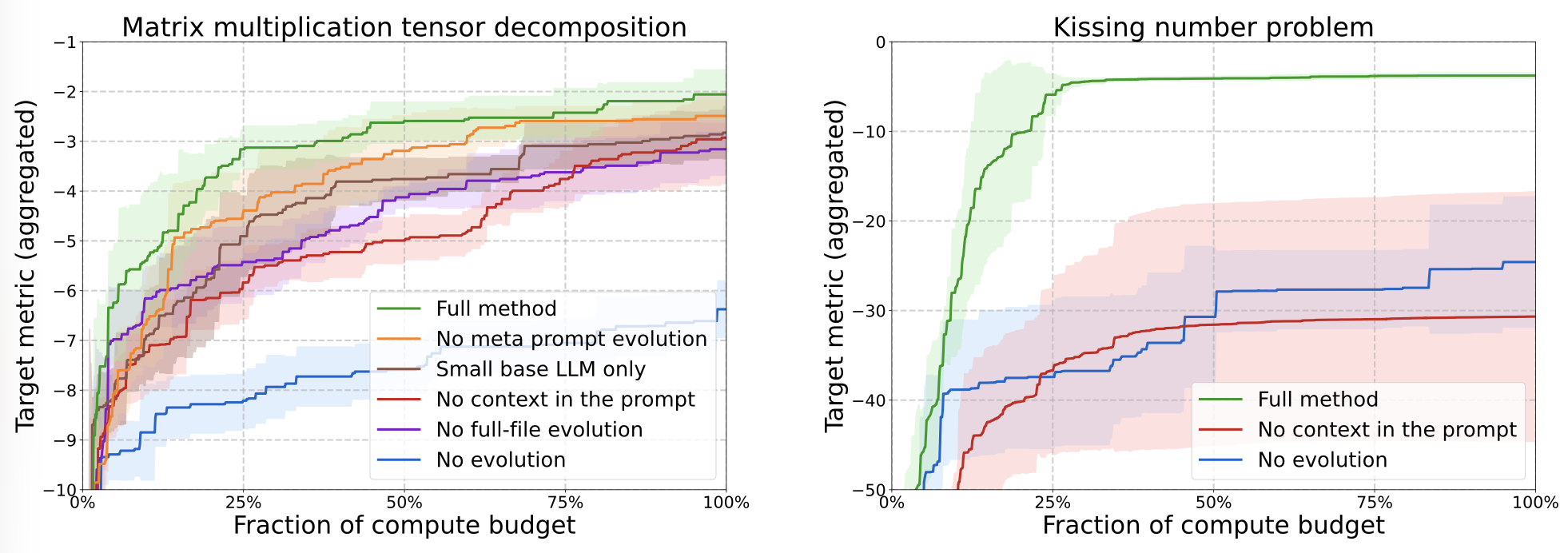
Novikov et al. "AlphaEvolve: A coding agent for scientific and algorithmic discovery." 2025.
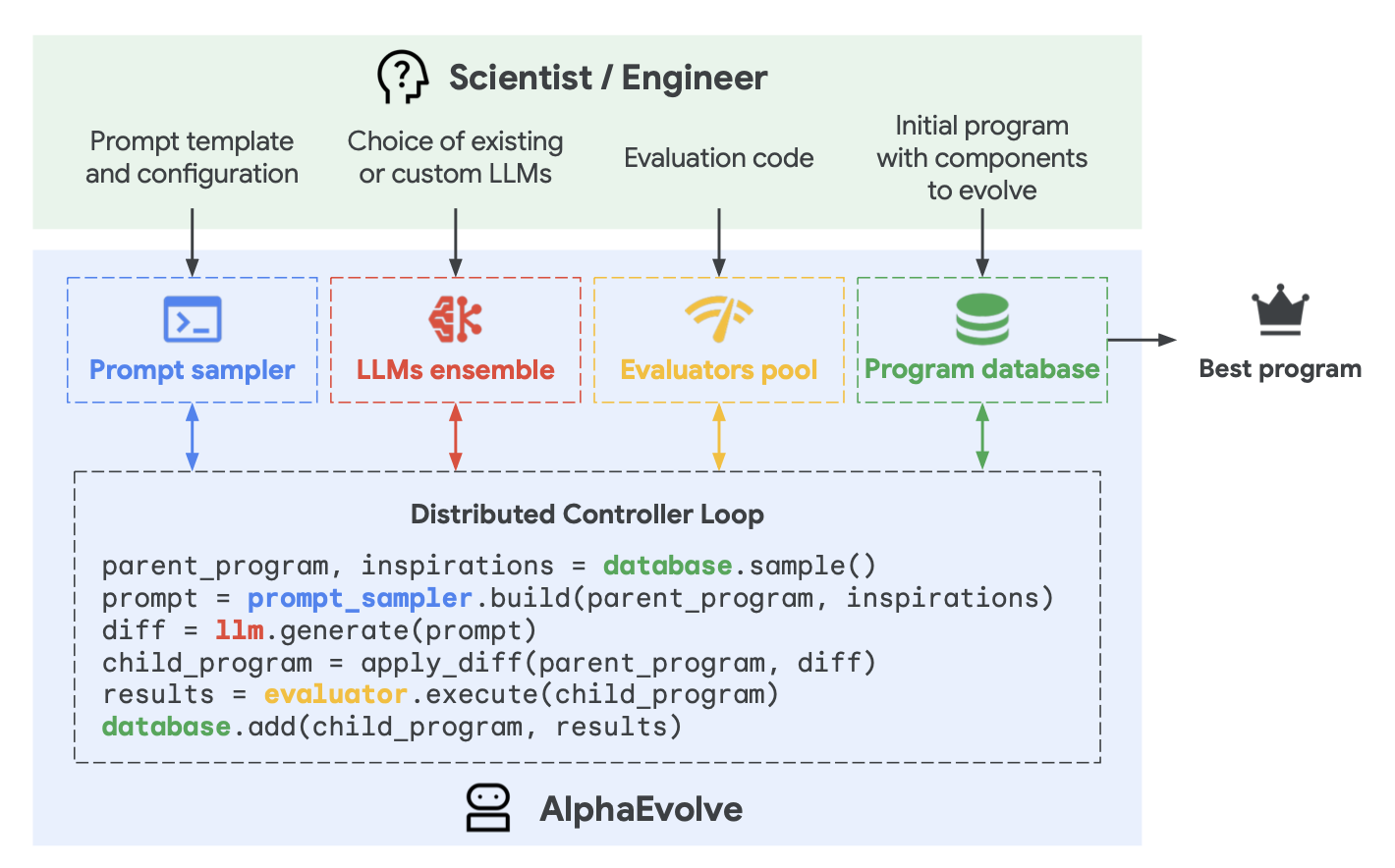
# EVOLVE-BLOCK-START / # EVOLVE-BLOCK-END to explicitly mark improvable regions
Zhang et al. "The Darwin Gödel Machine: Open-Ended Evolution of Self-Improving Agents." 2025.
- Initialize: start with one coding agent from the pool
- Select parent: probabilistically select a parent based on performance (probability inversely proportional to offspring count, encouraging exploration)
- Reflect + propose: the parent agent reviews its own benchmark evaluation logs and proposes harness improvements
- Mutate: modify the harness code to produce a new agent
- Evaluate: the new agent is evaluated on benchmarks; only agents with sufficiently high performance are added back to the pool
- Repeat: loop until the stopping condition is met
Experiments (based on Claude 3.5 Sonnet):
· SWE-bench Verified: 20% → 50% (+30 pp)
· Polyglot: 14.2% → 30.7% (+16.5 pp)
No human intervention required; the Agent autonomously evolved a stronger harness design.
Suitable scenarios
- Candidate solutions can be evaluated automatically
- Fitness is easy to quantify (numerical metrics)
- Matrix multiplication acceleration
- GPU kernel optimization
- Competitive programming
- Datacenter scheduling
Unsuitable scenarios
- Slow evaluation (hours per run)
- Vague or subjective evaluation criteria
- Primarily heuristic-based judgment
- Limited compute budget
- Requires human review steps
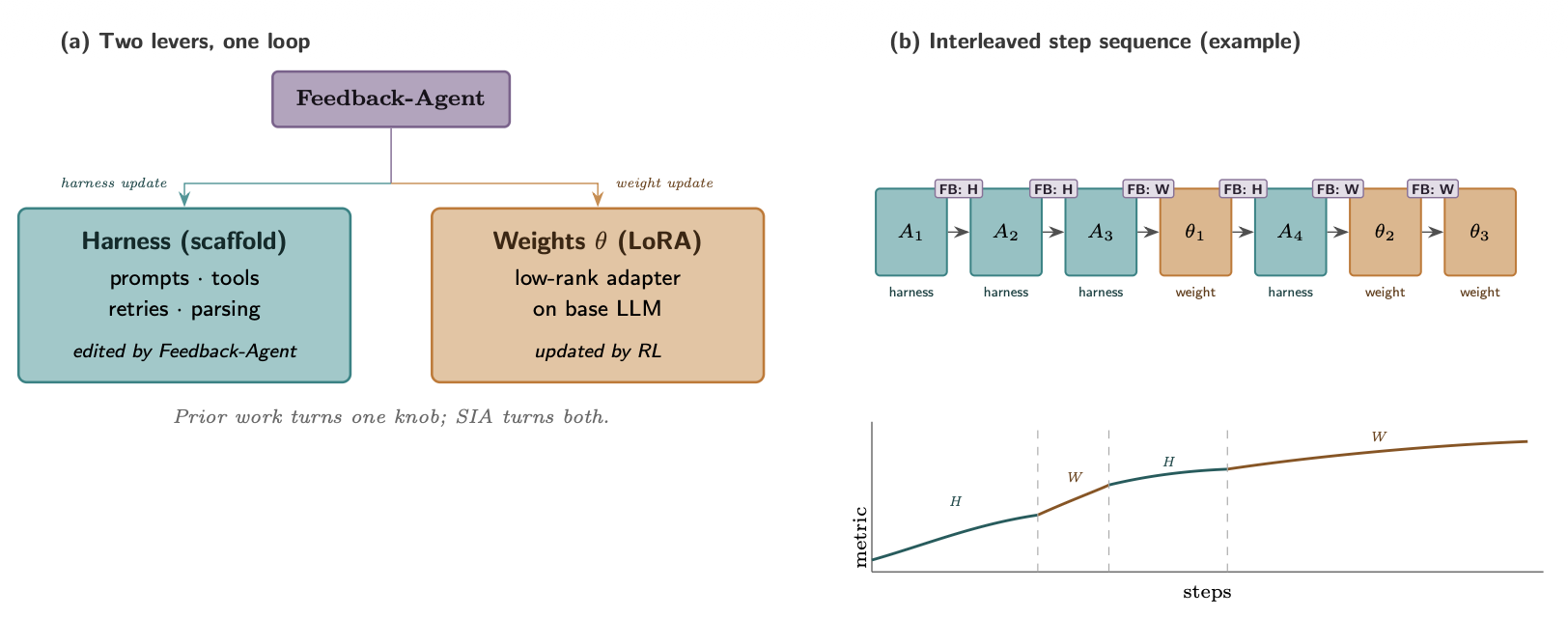
· Meta-Agent: proposes new harness designs
· Task-Specific Agent: executes tasks under the new harness
· Feedback-Agent: decides whether to update the harness or the model weights based on results
Promising direction, but evidence is preliminary: training stability and the Goodhart effect (optimizing proxy metrics causes real-goal degradation) remain open challenges.
Hebbar et al. "Self-Improving Agents." 2026.
The algorithmic cost curve in “The search space is too large, gradients are unavailable — evolution is the only practical answer”
“Novikov et al.” is not asking you to memorize steps. It trains you to spot repeated work: as the input grows, how many comparisons, moves, or recursive calls does the program perform?
Find repeated work before declaring something fast
Break “Zhang et al.” into three questions: how input size changes, what each round does, and whether the next round can shrink its search space. Big-O describes growth, not an exact time on every machine; constants, memory, and data distribution still matter.
- Initialize : start with one coding agent from the pool
- Select parent : probabilistically select a parent based on performance (probability inversely proportional to offspring count, encouraging exploration)
- Reflect + propose : the parent agent reviews its own benchmark evaluation logs and proposes harness improvements
Theoretical optimum is not always practical optimum
When AI writes an algorithm, trace a small input by hand and benchmark progressively larger inputs. That turns “Hebbar et al.” from a slogan into a performance claim you can check.
From “The search space is too large, gradients are unavailable — evolution is the only practical answer” to “Why Evolutionary Search Suits Harness Optimization”
“The search space is too large, gradients are unavailable — evolution is the only practical answer” grounds the problem in “A Harness is composed of prompts, tool-calling strategies, context management logic, and code snippets. The combination space of these components is vast and irregularly shaped — it cannot be directly optimized…”. “Why Evolutionary Search Suits Harness Optimization” then moves it toward “💬 Plain talk: Evolutionary search is the same trick nature uses to selectively breed crops : plant a lot, keep what grows well, discard what doesn't, occasionally crossbreed and mutate, and over generations th…”. Together, they show that the lesson is not just a conclusion to remember, but a claim with conditions.
Carry the judgment into the next situation
For a real task, find the repeated work first, ask how input size changes, and use a small benchmark to verify the theoretical judgment. Complexity should not become a label detached from the situation.
- “The search space is too large, gradients are unavailable — evolution is the only practical answer”: A Harness is composed of prompts, tool-calling strategies, context management logic, and code snippets. The combination space of these components is vast and irregularly shaped — it cannot be directly optimized…
- “Why Evolutionary Search Suits Harness Optimization”: 💬 Plain talk: Evolutionary search is the same trick nature uses to selectively breed crops : plant a lot, keep what grows well, discard what doesn't, occasionally crossbreed and mutate, and over generations th…
- “The closing point”: Evaluate : the new agent is evaluated on benchmarks; only agents with sufficiently high performance are added back to the pool
The final “The closing point” brings the discussion to “Evaluate : the new agent is evaluated on benchmarks; only agents with sufficiently high performance are added back to the pool”. The useful thing to carry forward is knowing which judgments must be revisited when input, scale, or risk changes.
I turned one judgment from this article into a small experiment I could run today. Knowing what to observe next is more useful than simply remembering the conclusion.
After reading this, I first looked for the conditions behind the idea instead of copying the method into a project. That order made the later trade-offs much clearer.
When this judgment reaches real work, which constraint should be added first? I am curious which step matters most between reading and the first practical attempt.
No discussion on this article yet.