Workflow Design: From Manual to Auto-Search
AI Scientist / ADAS / AFlow — using MCTS and Meta-Agents to search for optimal workflows
THE QUESTION THIS PAGE ANSWERS
ANSWER FIRSTWhat is the key idea behind “Workflow Design: From Manual to Auto-Search”?
AI Scientist / ADAS / AFlow — using MCTS and Meta-Agents to search for optimal workflows
Make the claim earn its place. Use this page as a decision aid, not a definition to memorize. Connect the idea to one real task, one observable result, and one failure that would change your mind.
Write one question you could answer with evidence after trying this idea.
A conclusion that sounds complete but leaves the key assumption untested.
Pipeline:
- Generate research idea
- →
- Write code
- →
- Run experiments
- →
- Analyze results
- →
- Write paper
- →
- Peer review
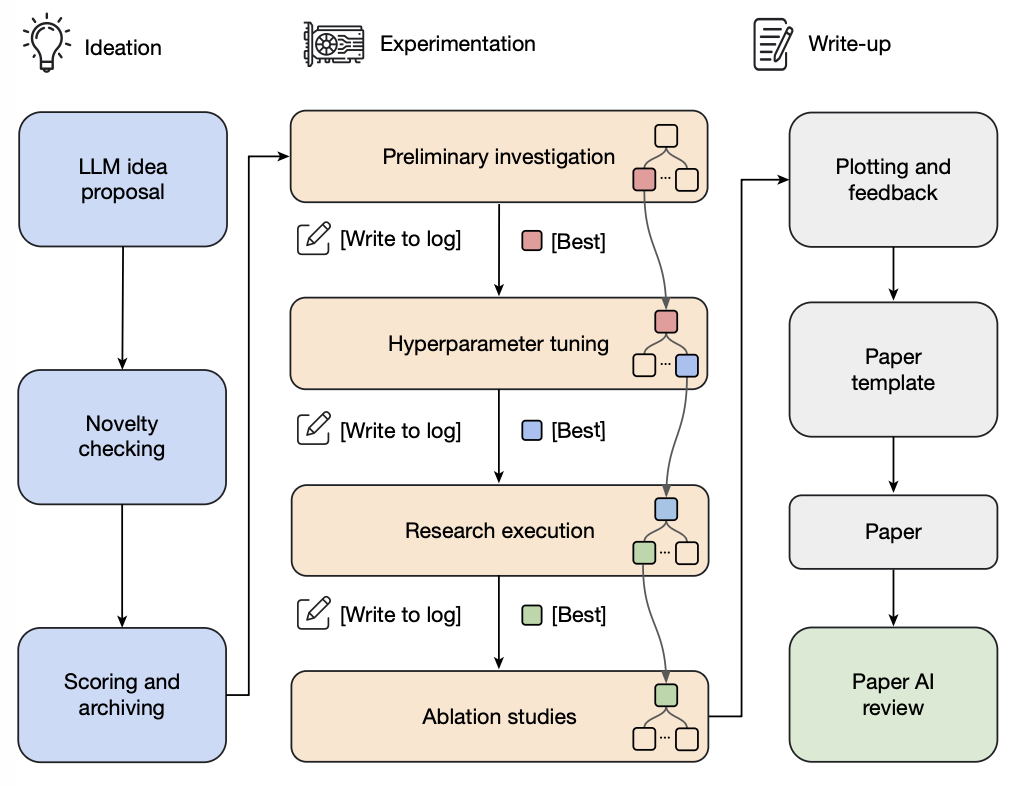
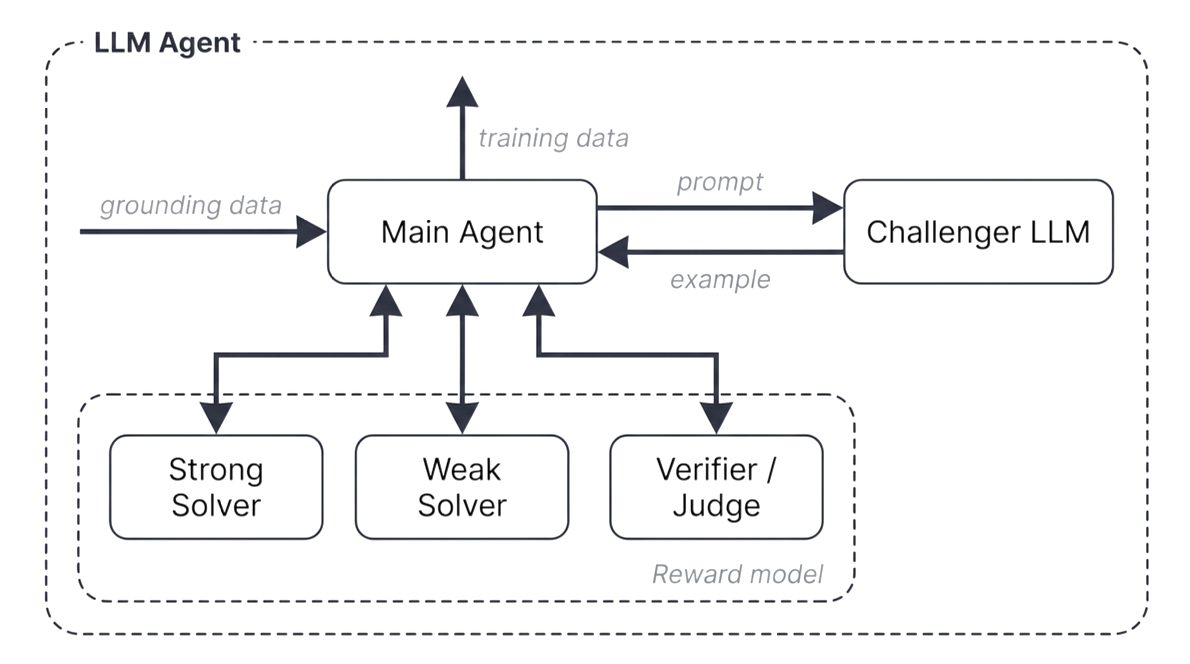
Role system:
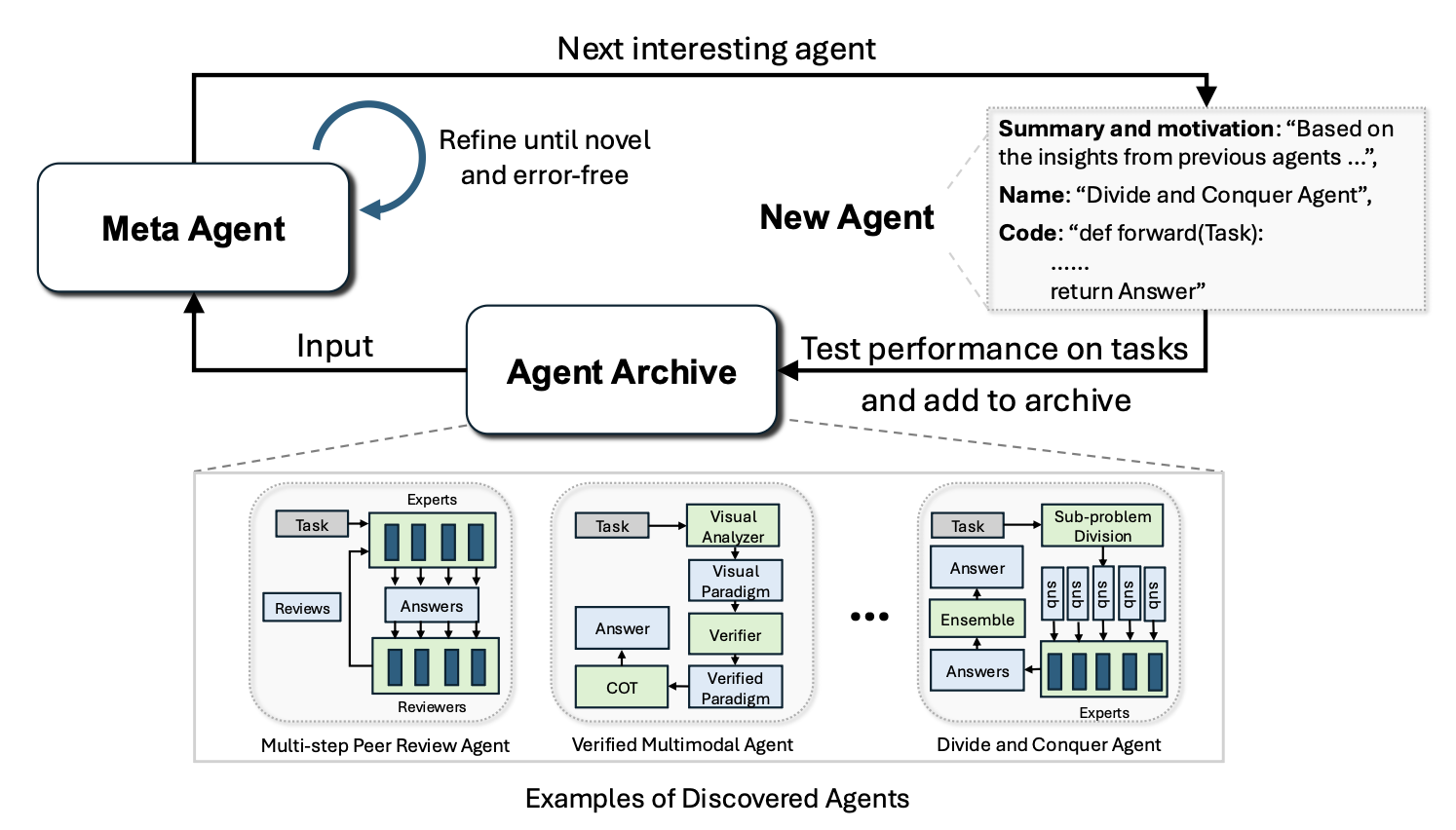
How it works:
1. Meta-Agent generates a high-level description (Agent architecture, tool usage, reasoning strategy)
2. Translates the description into executable code
3. Uses self-refine to check for novelty: ensures it's not simply repeating an existing solution
4. Evaluates on benchmark tasks, keeping the best-performing designs
Key innovation: Uses code as the representation of the Agent design search space, enabling designs to be automatically generated, modified, and evaluated.
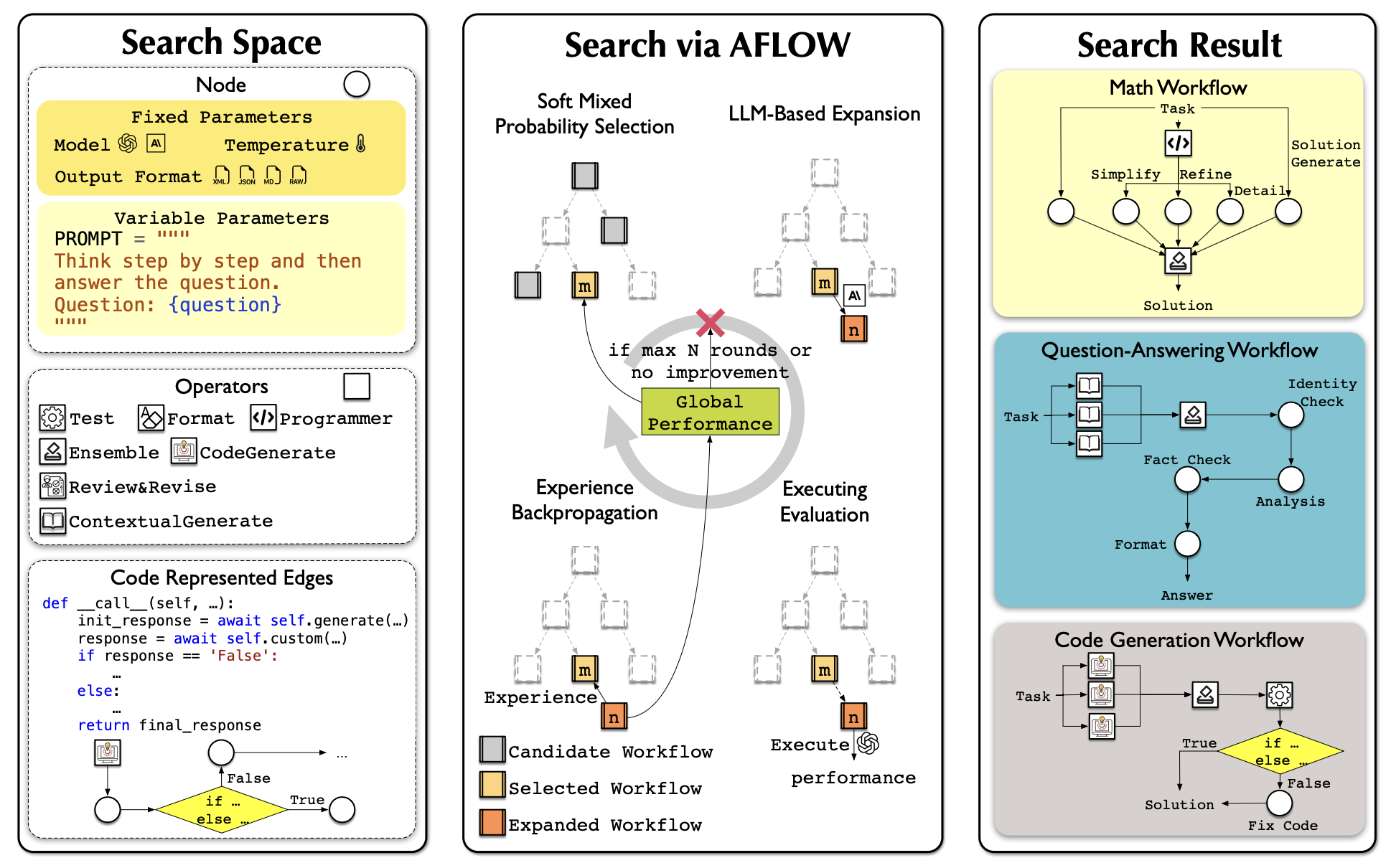
MCTS optimization process:
- Initialize the starting workflow as the root node of the search tree
- Use soft mixture of score and uniform exploration to select the node to expand (balancing exploitation and exploration)
- Let the LLM generate modified workflow variants (add/remove/modify nodes and edges)
- Execute and evaluate the new workflow's performance on the target task
- If there is improvement, add it back to the search tree as a new candidate
- Repeat until the top-k average score stabilizes or the compute budget is exhausted
| Method | Design approach | Search strategy | Core advantage |
|---|---|---|---|
| Manual design | Human expert iteration | None (intuition-based) | High interpretability |
| ADAS | Meta-Agent + code | Self-refine | Automated design |
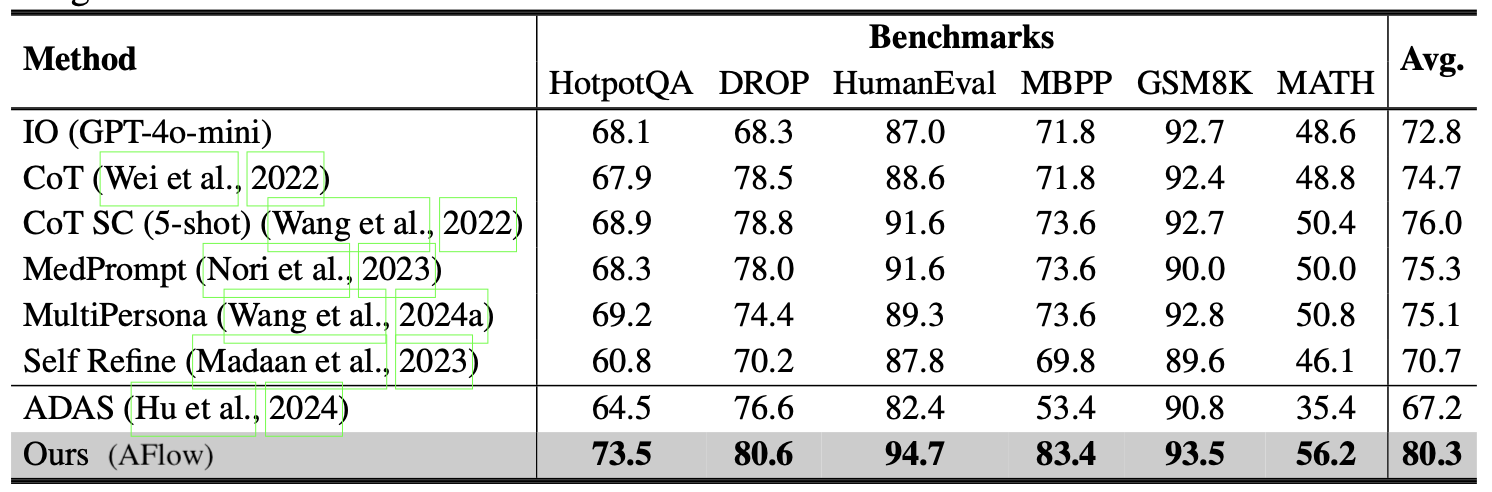
| AFlow | Graph representation + MCTS | Monte Carlo Tree Search | Systematic search + stable convergence |
Core Insights
- Enormous search space: The combinatorial possibilities for workflows far exceed what humans can manually explore — hand design only scratches the surface
- Design is search: Treat workflow design as a search problem; use algorithms (like MCTS) instead of intuition to find good solutions
- Code is the universal language: A Harness is fundamentally code that orchestrates prompts, tool calls, sub-Agents, control flow, memory, and workflow logic
- The evolution from ADAS to AFlow: Automation of Agent design keeps advancing — from having an LLM design it to having algorithms systematically search for it
Why “When the workflow itself becomes the search space, design shifts from art to engineering” depends on the operation
“AI Scientist / ADAS / AFlow — using MCTS and Meta-Agents to search for optimal workflows” makes the structure concrete. The useful comparison is not which name sounds more advanced, but how the data is arranged and how far the most common operation has to travel.
Read a structure through access and change
“AI Scientist / ADAS / AFlow — using MCTS and Meta-Agents to search for optimal workflows” exposes a trade-off that is easy to miss: reading by position, looking up by key, adding at either end, inserting in the middle, and traversing relationships do not favor the same organization. A structure that is fast for one operation is not automatically fast for all of them.
- Generate research idea
- Initialize the starting workflow as the root node of the search tree
- Use soft mixture of score and uniform exploration to select the node to expand (balancing exploitation and exploration)
Count scale and update frequency together
Use “AI Scientist / ADAS / AFlow — using MCTS and Meta-Agents to search for optimal workflows” as a boundary check. Write down the data size, the dominant operation, and the latency you can accept before deciding whether an AI-generated structure actually fits.
From “When the workflow itself becomes the search space, design shifts from art to engineering” to “Hand-Designed Workflows”
“When the workflow itself becomes the search space, design shifts from art to engineering” grounds the problem in “From fully hand-crafted pipeline design to using MCTS to automatically discover optimal workflows, the design paradigm for Agent systems is undergoing a fundamental shift. Code is the universal language for def…”. “Hand-Designed Workflows” then moves it toward “💬 Plain talk: A workflow is like a task checklist for the AI. Like onboarding a new employee, you have to tell them "do A first, then B, and if something goes wrong check with C." These checklists used to be w…”. Together, they show that the lesson is not just a conclusion to remember, but a claim with conditions.
Carry the judgment into the next situation
When you meet a new data structure, do not begin by memorizing its definition. Write down the most frequent operation, estimate scale and update behavior, and check whether the structure satisfies all three conditions.
- “When the workflow itself becomes the search space, design shifts from art to engineering”: From fully hand-crafted pipeline design to using MCTS to automatically discover optimal workflows, the design paradigm for Agent systems is undergoing a fundamental shift. Code is the universal language for def…
- “Hand-Designed Workflows”: 💬 Plain talk: A workflow is like a task checklist for the AI. Like onboarding a new employee, you have to tell them "do A first, then B, and if something goes wrong check with C." These checklists used to be w…
- “The closing point”: Execute and evaluate the new workflow's performance on the target task
The final “The closing point” brings the discussion to “Execute and evaluate the new workflow's performance on the target task”. The useful thing to carry forward is knowing which judgments must be revisited when input, scale, or risk changes.
I turned one judgment from this article into a small experiment I could run today. Knowing what to observe next is more useful than simply remembering the conclusion.
After reading this, I first looked for the conditions behind the idea instead of copying the method into a project. That order made the later trade-offs much clearer.
When this judgment reaches real work, which constraint should be added first? I am curious which step matters most between reading and the first practical attempt.
No discussion on this article yet.